LAKE PEND OREILLE stretches nearly 50 lineal miles from Sandpoint to Idlewilde Bay at Farragut State Park, and carries a wide diversity of catchable species besides the Kamloops, such as whitefish, cutthrout and brown trout, mackinaw or lake trout, large and smallmouth bass, crappie, pumpkinseed sunfish, perch and bullhead (catfish). The list goes on with peno, northern pikeminnow, tench, suckers, sculpin and a variety of smaller minnows.
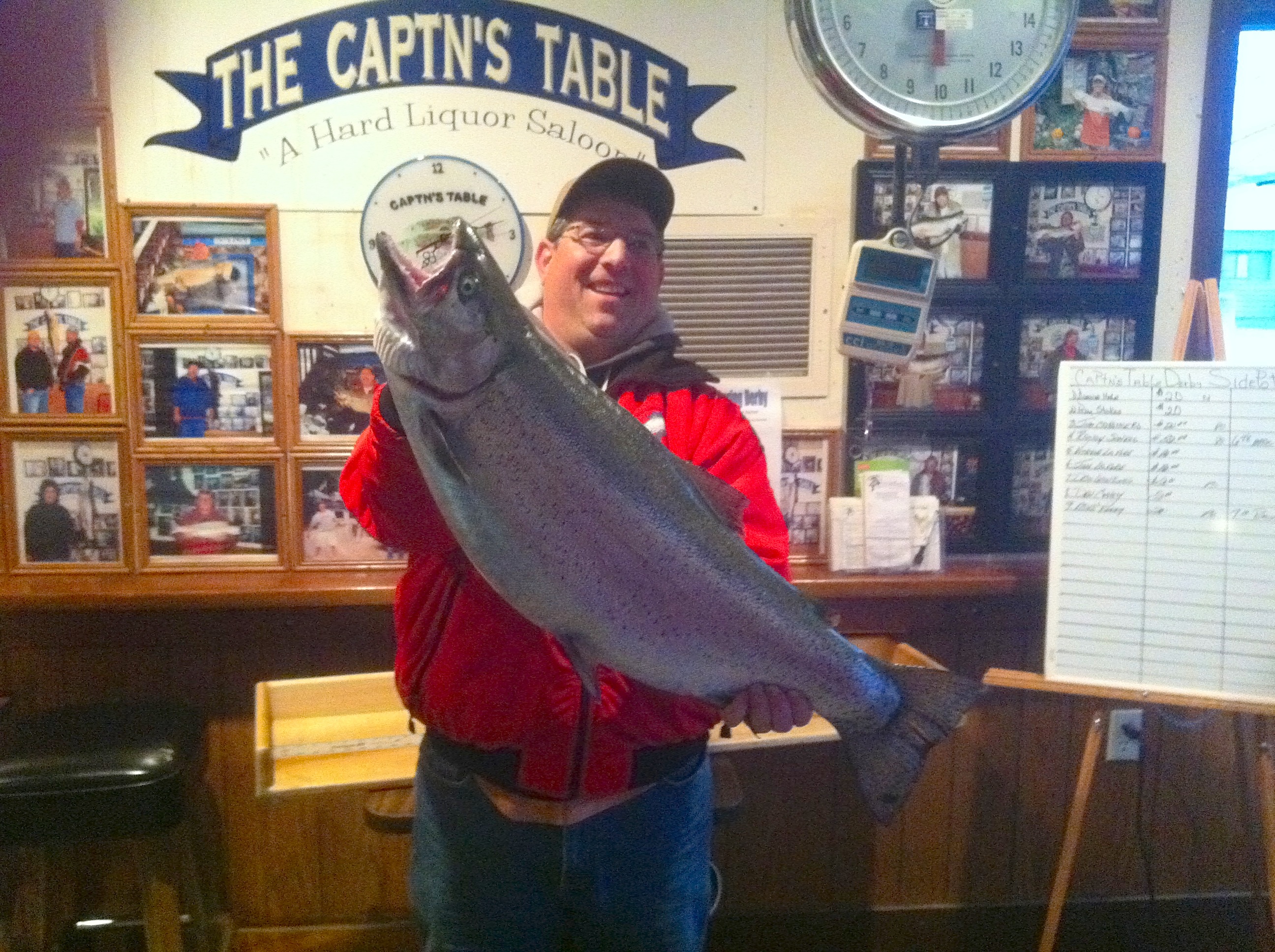
The Kamloops trout is actually a Gerrard rainbow, first stocked into the system in 1941. The Gerrard is a long-living wild strain of rainbow native to the Lardeau River which flows into the Kootenay Lake in Canada, just north of the United States. The Gerrard is well adapted to the cold waters of Pend Oreille and spawns successfully in the wild. That's a picture of a trophy Gerrard, above, hoisted by fisherman Clint Nicholson.
Now and then a lucky angler will catch a hybrid "cutbow," a cross between a cutthroat and a rainbow. The largest cutbow taken in Idaho was a 24-pounder caught here in 1991 by Irwin Donart.
In 1995, Jim Eversole caught the largest game fish ever taken from Lake Pend Oreille, a 43 pound, 6 ounce mackinaw also known as the lake trout.
Lake Pend Oreille still holds the world record for non-genetically engineered rainbow trout, a 37-pounder caught in 1947 by Wes Hamlet.
One reason these fish, historically and today, get so big is the abundance of kokanee, a small variety of landlocked sockeye salmon commonly called "bluebacks" or "silvers" that are the prey-base in their food chain. At one time the abundant kokanee fishery in Lake Pend Oreille, which numbered millions of fish, attracted anglers from far and wide with daily catch limits of 25 kokanee per person. Unfortunately, the kokanee fishery suffered serious declines beginning in the 1990s, which in turn resulted in a decline in the Kamloops fishery.
To restore these prime fisheries, a huge effort of more than a decade was undertaken by local anglers, Idaho Fish & Game and the Lake Pend Oreille Idaho Club (LPOIC.org) members to establish a more balanced predator-prey relationship. It included the controversial removal over several years of the large mackinaw and Kamloops that feed on the kokanee population. At the same time a sustained effort to rebuild kokanee stocks included a ban on fishing along with harvest each year of millions of kokanee eggs, which are hatched and raised in fish hatcheries to supplement the natural spawning of the kokanee in gravel beds around Lake Pend Oreille and many tributary streams.
The aggressive management efforts have paid off, with the kokanee fishing once again allowed and the Kamloops rebounding, with 20-pound-plus trophies not unusual. Fishermen in quest of either the big Kams or mackinaw, or the small but tasty kokanee, pursue their game trolling by boat with specialized lures and techniques; for the new or unacquainted, one of the many fishing charters available are the best bet for success. See charter choices in the Sandpoint Online Business Directory.
For shoreline fishing on Lake Pend Oreille, many species can be found including crappie, perch, pumpkinseed, bass, bullheads, brown trout and cutthroat.
Pend Oreille was one of the last few lakes in the interior United States where it was still legal to catch bull trout before that species was listed as threatened under the Endangered Species Act; fishing for bull trout is no longer allowed.
Pend Oreille holds the record for the bull trout with a whopping 32-pounder caught in 1949 by Nelson Higgins. For more information on the bull trout, contact Idaho Fish and Game (208-263-5111).
As for whitefish, Pend Oreille has two varieties, both very good for eating. The Rocky Mountain whitefish, the smaller of the two, is generally found in water less than 50 feet deep. In the winter, you'll find this variety west of the Long Bridge.
The second variety is the Lake Superior whitefish, introduced here in the '30s. They are arguably the best tasting fish in these waters; superb eating, very meaty with few bones and firm flesh; but probably the least fished-for of all the lake's species. They swim in large schools and at depths between 80 to 200 feet. They range in weight from 2 to 7 pounds, and feed primarily on plankton and mysis shrimp (as do the kokanee).
The lake also has a population of largemouth bass, often overlooked. You'll find them in the shallows around the mouth of Pack River and farther east in the waters around Denton Slough near the mouth of the Clark Fork.
Lake Pend Oreille also has smallmouth bass. They love rocky underwater ledges, and those who are in-the-know fish for them along the Green Monarchs.
But no matter where you fish in Lake Pend Oreille, it's a good bet you'll have a great day on the water!